









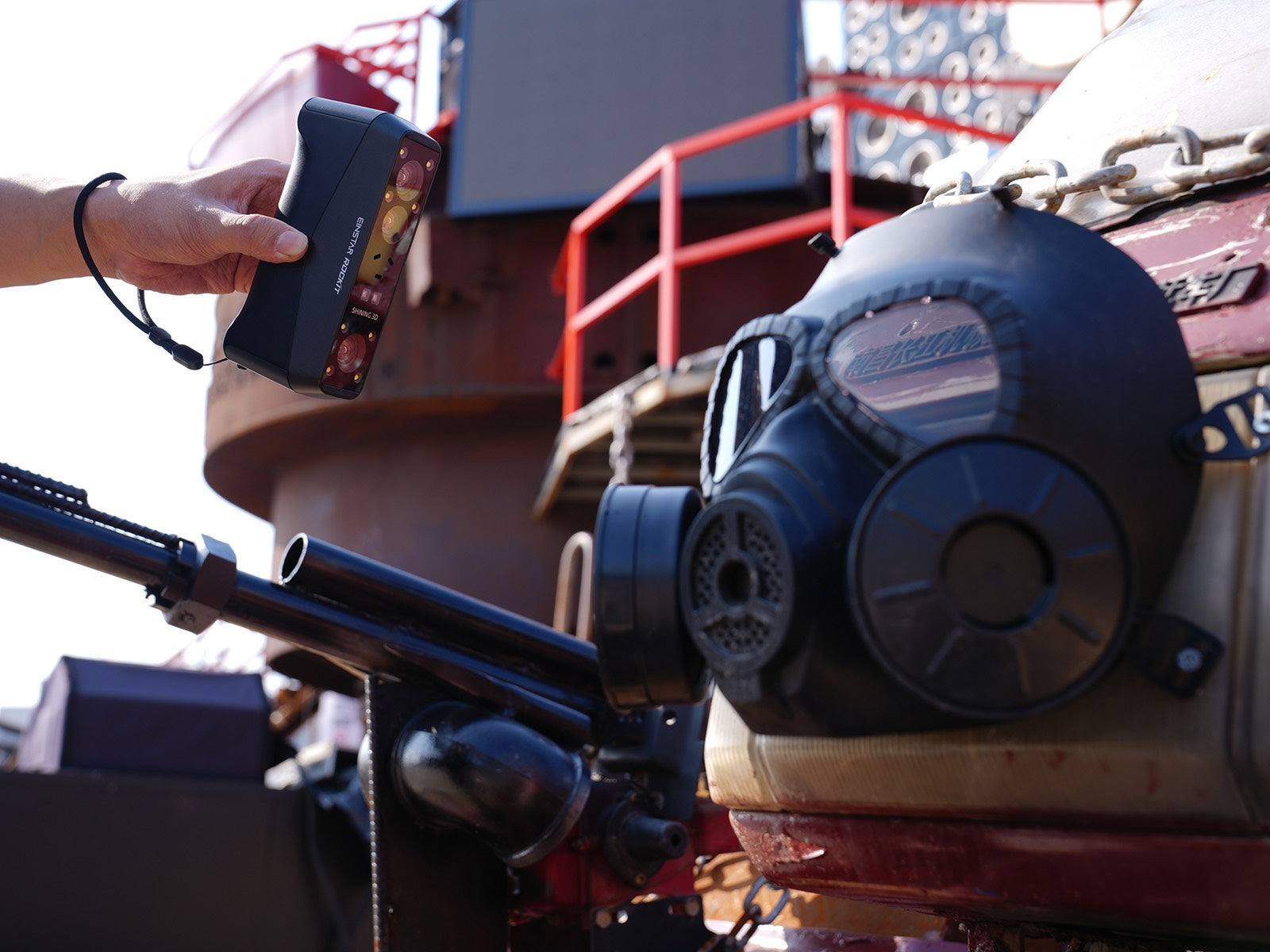
When it comes to automotive design, customization, and restoration, black and reflective surfaces have long been a major challenge for 3D scanning—especially for handheld or lightweight devices.
These surfaces tend to absorb light, confuse tracking systems, and produce incomplete or noisy scan data. But a new generation of 3D scanners is changing that.
Enter the EINSTAR Rockit—a breakthrough handheld 3D scanner designed to capture dark, glossy, and reflective surfaces with exceptional accuracy.
Let’s explore why this device is gaining traction in the U.S. automotive market—and how it turns a long-standing problem into a competitive advantage.
Why Black Surfaces Are Difficult to Scan
Traditional handheld 3D scanners struggle with black paint, gloss finishes, and metallic surfaces due to several limitations:
- Dark materials absorb projected light
- Gloss and reflections disrupt tracking
- Point clouds become noisy or incomplete
These challenges make it difficult for automotive professionals to generate reliable 3D models—until now.

Dual Scanning Modes for Every Surface
The EINSTAR Rockit overcomes these issues with an advanced hybrid light system:
- 38 Laser Lines (19 + 19 Crossed Blue Lasers): Capture dense data for complex geometries
- 7 Parallel Blue Laser Lines: Enhance edge detail and fine features
- IR VCSEL Mode: Performs exceptionally well on dark and reflective surfaces
This powerful combination makes Rockit ideal for scanning automotive parts that were previously difficult—or even impossible—to capture accurately.
High-Speed Scanning for Automotive Workflows
Efficiency is critical in automotive customization and repair. The Rockit delivers industry-leading performance:
- Laser HD Mode: Up to 2,800,000 points per second
- IR Rapid Mode: Up to 4,800,000 points per second
These speeds allow you to complete detailed scans quickly—whether capturing a bumper, fender, wheel arch, or full component geometry.
Flexible Scanning Range for Any Car Part
The EINSTAR Rockit adapts easily to different object sizes and scanning distances:
- Crossed Laser Mode: 100–600 mm working distance
- Parallel Laser Mode: 100–400 mm
- IR Rapid Mode: 160–1400 mm
This flexibility makes it suitable for both small parts and larger vehicle sections—without changing equipment or setup.
Built for Real-World Automotive Environments
The Rockit is designed for real-world conditions—not just controlled studio environments:
- Operates in bright outdoor lighting (up to 110,000 Lux)
- Supports both marker-free and marker-based alignment
- Wireless scanning via built-in Wi-Fi
This makes it ideal for auto shops, collision repair centers, restoration projects, and on-site scanning tasks.
Why EINSTAR Rockit Matters for Car Modification
For automotive professionals, the EINSTAR Rockit directly solves key challenges:
Scan Black, Glossy, and Reflective Surfaces
Capture accurate data without relying on sprays or complex preparation.
Accelerate Reverse Engineering
Quickly generate precise 3D models for custom parts, repairs, and redesigns.
Seamless CAD and 3D Printing Integration
Export files in STL, OBJ, PLY, and 3MF formats for immediate use.
Improve Shop Efficiency
Reduce manual measurements and save hours in modeling and design workflows.
Whether you're building custom parts, restoring vehicles, or creating digital assets, the Rockit is designed to keep up with professional demands.
Conclusion: A New Standard in Automotive 3D Scanning
For years, black and reflective surfaces have been the biggest obstacle in handheld 3D scanning.
The EINSTAR Rockit changes the game by combining laser and infrared technologies, high-speed data capture, and real-world usability.
If you're working in automotive design, customization, or digital manufacturing, this scanner helps you work faster, more accurately, and with fewer limitations.
Upgrade your automotive scanning workflow today.
Share:
The Best 3D Scanner for Large Objects in 2024: A Comprehensive Review
From Physical to Printable: Why EINSTAR 2 is the Ultimate 3D Scanner for 3D Printing