









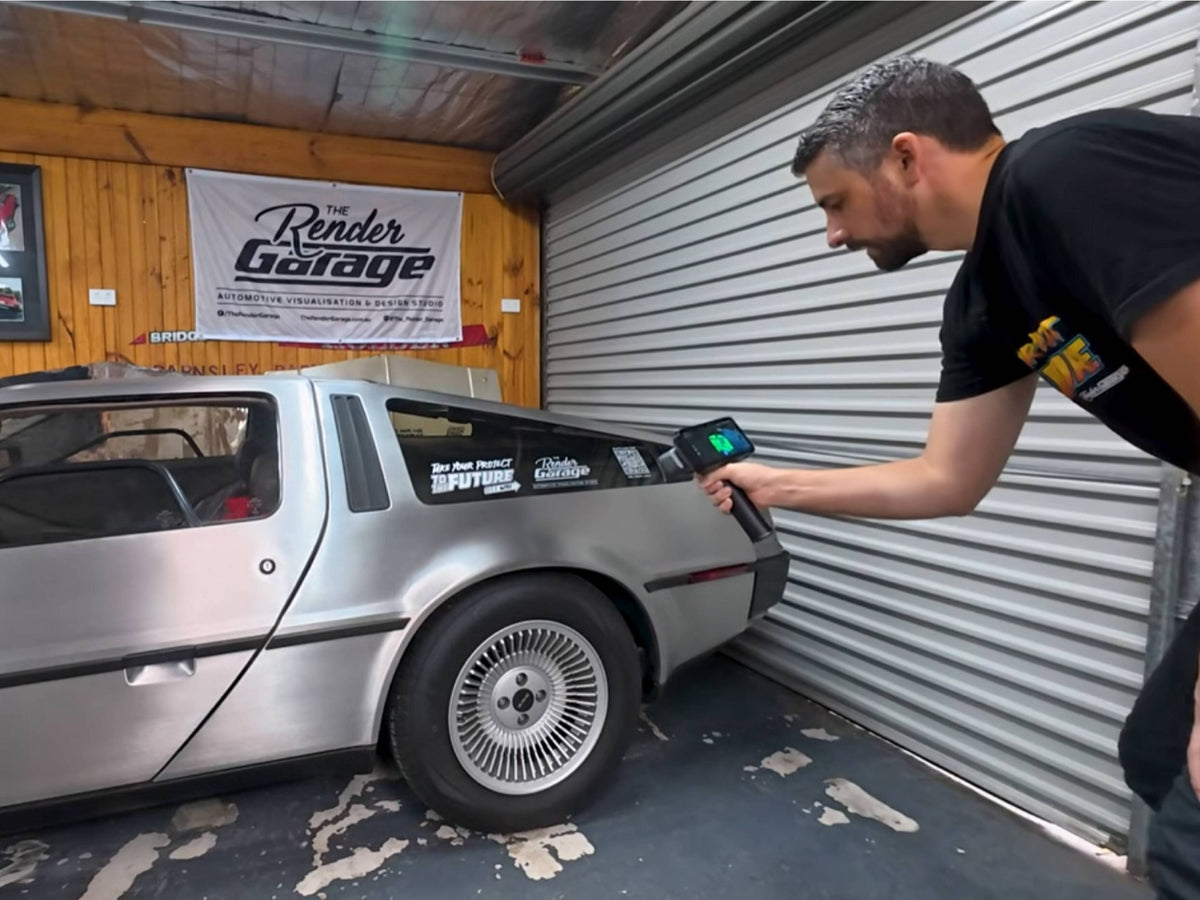
From Field to Studio: A Professional Vehicle Scanning Perspective on the EinScan Rigil 3D Scanner
In today’s fast-evolving automotive industry, 3D vehicle scanning technology has become an essential tool for professionals involved in reverse engineering, aftermarket customization, collision analysis, and digital archiving. Choosing the right scanner can significantly impact accuracy, workflow efficiency, and final output quality. The EinScan Rigil 3D scanner stands out as a powerful, portable solution designed to meet the demanding needs of vehicle scanning professionals—seamlessly bridging fieldwork and studio applications.

Why the EinScan Rigil Is Ideal for Vehicle Scanning
From a professional automotive scanning perspective, flexibility is critical. Vehicles are complex, large-scale objects with diverse surfaces and geometries. The EinScan Rigil’s multiple scanning modes provide a major advantage in adapting to different scanning scenarios.
In 38 lines blue laser mode, users can easily move around the vehicle to capture full exteriors, including body panels, bumpers, doors, and aerodynamic structures. This is particularly beneficial in real-world environments such as repair shops, garages, or outdoor locations where repositioning the vehicle is impractical.
For high-precision automotive parts scanning, such as engine components, interior structures, or small mechanical assemblies, the 7 Parallel lines blue laser mode delivers enhanced stability and repeatability. This ensures accurate capture of fine details and tight tolerances—critical for reverse engineering workflows.
High-Accuracy 3D Scanning for Automotive Applications
Accuracy is at the core of any professional 3D vehicle scanning workflow. The EinScan Rigil utilizes advanced structured light technology to produce high-resolution meshes with excellent geometric fidelity. This allows professionals to accurately capture:
- Complex curved surfaces (car bodies, fenders)
- Fine mechanical details (engine parts, brackets)
- Aerodynamic structures and contours
Such precision is essential for downstream applications like CAD modeling, surface analysis, and part validation. With reliable scan data, engineers and designers can confidently move forward with digital reconstruction and manufacturing processes.
Stable Tracking for Challenging Vehicle Surfaces
One of the biggest challenges in automotive scanning is dealing with reflective paint, glossy finishes, and low-feature surfaces. These conditions often cause tracking loss or data inconsistencies.
The EinScan Rigil addresses this with a robust tracking system, helping maintain alignment even on difficult surfaces. For professionals, this means:
- Fewer interruptions during scanning
- Reduced need for rescanning
- Improved workflow efficiency
In practice, this stability is especially valuable when scanning large vehicle exteriors or uniform surfaces like doors and hoods.
Portable 3D Scanner for On-Site Vehicle Scanning
Portability is a key factor for modern automotive professionals. Unlike traditional stationary systems, the EinScan Rigil portable 3D scanner can be used directly in the field.
This is particularly useful for:
- Accident reconstruction and forensic analysis
- On-site vehicle inspection and documentation
- Scanning rare or immovable vehicles
Its lightweight and ergonomic design also reduces operator fatigue, making it suitable for long scanning sessions—an important consideration in professional environments.
Seamless Workflow: From Field Capture to Studio Processing
A major advantage of the EinScan Rigil is its ability to streamline the entire vehicle scanning workflow—from data acquisition to final output.
After capturing data in the field, users can quickly transition to studio processing using the integrated software. Key features include:
- Automatic alignment and registration
- Noise reduction and mesh optimization
- Export to industry-standard formats
This enables smooth integration with popular automotive design software such as SolidWorks, EXModel, and Geomagic. For professionals working in reverse engineering or custom part fabrication, this compatibility is essential for efficient project execution.
Real-World Considerations for Automotive Scanning
While the EinScan Rigil offers strong performance, professionals should be aware of practical factors that influence results:
- Lighting conditions can affect structured light scanning
- Reflective or transparent surfaces may require scanning spray
- High-resolution data processing benefits from a powerful workstation
By optimizing these conditions, users can achieve the best possible scanning results and maintain consistent data quality.
Conclusion: A Professional-Grade 3D Scanner for Vehicle Applications
From a vehicle scanning professional’s perspective, the EinScan Rigil 3D scanner delivers an impressive combination of accuracy, portability, and workflow efficiency. Its dual-mode flexibility allows seamless operation across both field and studio environments, making it a versatile tool for a wide range of automotive applications.
Whether you are capturing a full vehicle exterior, performing automotive reverse engineering, or scanning precision components, the EinScan Rigil provides the performance and reliability needed to meet industry demands.
As 3D scanning in the automotive industry continues to evolve, solutions like the EinScan Rigil are helping professionals work smarter, faster, and with greater confidence—transforming how physical vehicles are converted into precise digital assets.
Share:
Best 3D Scanner for Large Sculptures: Why EINSTAR VEGA Is a Smart Choice
Why EINSTAR Rockit Makes Reverse Engineering Faster, Smarter, and More Accessible