









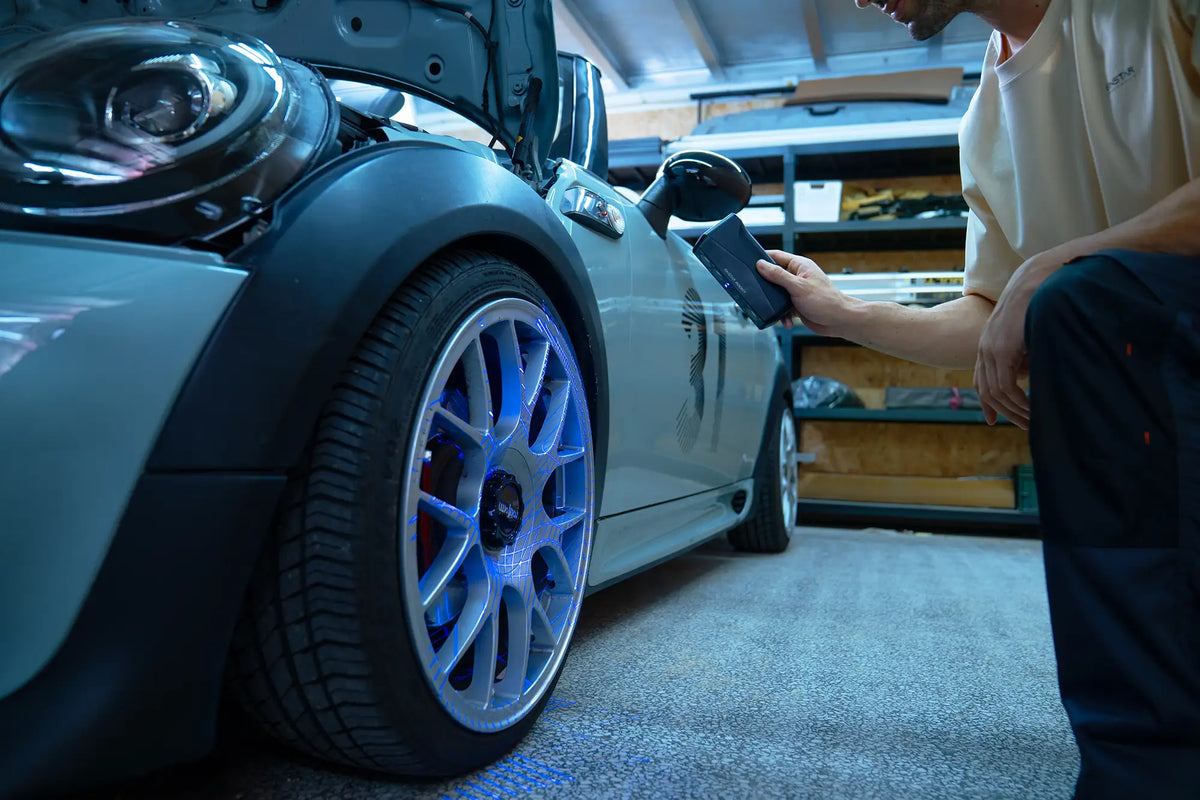
The Rockit is positioned by EINSTAR as a wireless 3D scanner with marker-free capability laser scanning, dual light sources, and a compact design intended to work “whenever and wherever you are.” That combination immediately makes it more interesting than many entry-level scanners that depend heavily on cables, adapters, and controlled indoor setups.
It is also priced for the prosumer market. The page lists the EINSTAR Rockit at $1,899, under $2000 category.
Who the EINSTAR Rockit Is For
The Rockit is not just for one type of user. Its feature set maps well to several practical industries and workflows.
The scanner is especially well suited to automotive customization, where it can generate high-quality 3D data for body kits, trim, and accessories. It also highlights cultural creation and art customization as well as research and education, emphasizing the scanner’s mobility, intuitive software, and low learning curve.
That makes this scanner relevant for:
- automotive shops
- reverse engineering workflows
- design studios
- educators and research labs
- artists and cultural preservation teams
- AR/VR and digital content creators
Why Wireless Really Matters
One of the most important reasons this product stands out in an EINSTAR Rockit is that the wireless workflow appears to be a core design feature rather than a secondary accessory.
It includes a built-in Wi-Fi module, does not require an extra hub or adapter, offers stable real-time sync to PC, and includes a built-in swappable battery with up to 3 hours runtime.
That solves a real pain point in scanning. When you are moving around a large object, a car, a statue, or a crowded workspace, cables slow you down. A cable-free workflow can reduce friction, reduce setup time, and make scanning more accessible to teams that are not deeply technical.
For shops and creators who want a portable laser 3D scanner, this is a meaningful advantage rather than just a lifestyle feature.
Marker-Free Scanning Improves Efficiency
Another standout feature is the Rockit’s marker-free laser scanning for feature-rich objects. The users can skip markers and get results faster.
That matters because markers are one of the quiet productivity killers in 3D scanning. They add preparation time, increase friction, and make repeated scanning less efficient. For businesses, that lost time translates into lower throughput. For hobbyists and educators, it creates an unnecessary learning barrier.
When a scanner can handle more projects with fewer prep steps, it becomes easier to recommend. That is one reason the Rockit fits so well into searches for best handheld 3D scanner and easy-to-use 3D scanner.
Blue Laser Modes Expand Real-World Use Cases
The Rockit also earns attention because of its light-source setup. EINSTAR specifies:
- 38 crossed blue laser lines (19 + 19) for fast, large-area capture
- 7 parallel blue laser lines for fine features
- IR VCSEL for fast scanning of medium to large objects
This multi-mode approach broadens the scanner’s use cases. A small detailed component and a larger object do not demand exactly the same scanning behavior. Having multiple capture modes makes the Rockit more flexible for mixed workflows.
Better Handling of Black and Reflective Surfaces
A budget scanner can look attractive until it meets glossy paint, black plastic, chrome, or reflective industrial parts. This is where the Rockit appears especially strong.
It offers reliable performance on black and reflective surfaces and works on these materials without spray. Rockit can capture everything from matte plastics and carbon fiber to glossy paint and chrome finishes without spraying.
Outdoor Scanning and Mobility
The Rockit is also built for outdoor and bright-light use. The scanner is ready for outdoor scanning, supports varied lighting conditions, and can handle up to 110,000 lux in Laser HD mode and 70,000 lux in IR Rapid mode.
That makes it relevant for scanning statues, sculptures, public objects, and on-site design references. Combined with its compact dimensions and light weight, the scanner offers a workflow that is not tied to a single room or production bench. A spec page lists it at 425 g with battery, underscoring its portability.
Color Capture and Software Ecosystem
The final reason the Rockit deserves attention is that the user experience extends beyond raw scanning. The device includes a 5MP color camera and runs on EXStar Hub Software, which is designed to streamline workflows and provide model processing and optimization tools.
For digital artists, educators, and creative professionals, that means the scanner is useful not only for capturing geometry but also for building textured assets and moving more smoothly into downstream software workflows.
Final Review Verdict
If you are comparing handheld scanners in this price band, the EINSTAR Rockit review comes out strong for one reason above all: it addresses the practical problems that make affordable scanning frustrating. It is wireless, marker-free, compact, and built to deal with black and reflective surfaces while also supporting outdoor scanning and vivid texture capture. The specs such as the built-in Wi-Fi workflow, blue laser modes, 5MP color camera, and a current price of $1,899.
Learn more or explore full specifications here: EINSTAR Rockit Product Page
Share:
How EINSTAR ROCKIT Solves the "Large Scale" 3D Scanning Headache
Best 3D Scanner for Large Sculptures: Why EINSTAR VEGA Is a Smart Choice