









Why the Automotive Aftermarket Needs a New Kind of 3D Scanner
The automotive aftermarket thrives on customization, restoration, and rapid repair. Traditional measurement methods and even older, tethered 3D scanners struggle with the industry's demands: complex geometries, tight deadlines, and the need to work in cramped spaces like engine bays or under dashboards. Professionals need a tool that is as mobile as they are, capable of capturing high-fidelity data without the setup time or confinement of a dedicated scanning booth.
EINSTAR Rockit: Your Pocket-Sized, Professional Scanning Powerhouse

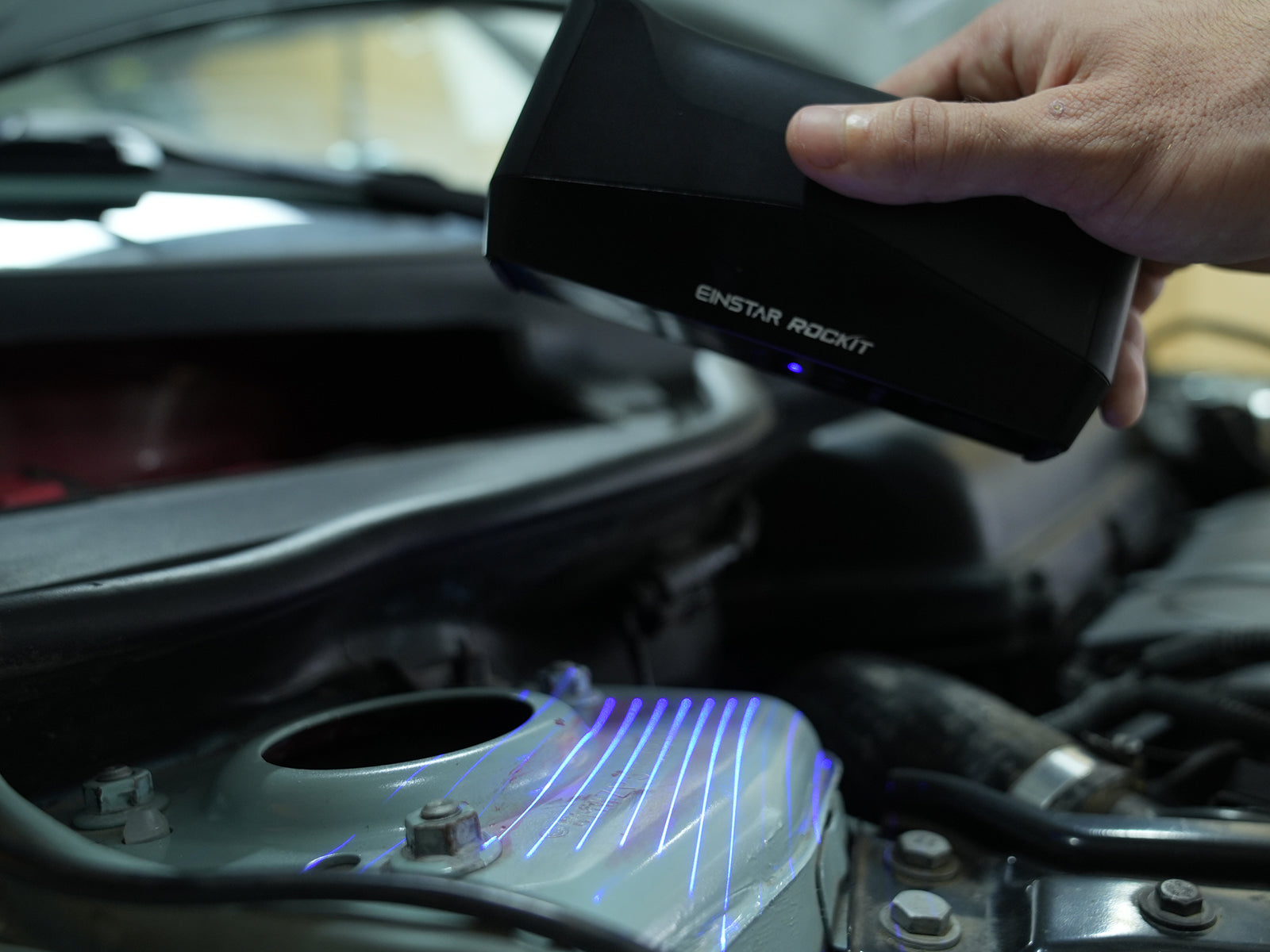
The EINSTAR Rockit is a portable handheld 3D scanner engineered to meet these challenges head-on. Designed as a "pocket-sized" device weighing only 425 grams, it liberates 3D scanning from the cable and power outlet[citation:1][citation:3]. Its core mission is to bring the scanner to the object, streamlining workflow for automotive enthusiasts, restorers, and custom shops alike[citation:10].
Core Advantages for Automotive Professionals: A Snapshot
| Challenge | Traditional Methods / Old Scanners | EINSTAR Rockit Solution |
|---|---|---|
| Mobility & Setup | Cables limit movement; requires power outlets; time-consuming setup. | Fully wireless 3D scanner with hot-swappable batteries (up to 3-hr runtime). Start scanning in minutes[citation:1][citation:10]. |
| Scanning in Tight Spaces | Bulky equipment can't access engine compartments or underbody areas. | Compact, pocket-sized design allows access to confined areas for detailed part capture[citation:3]. |
| Material & Surface Diversity | Struggles with dark, shiny, or textured surfaces like black trim, chrome, or upholstery. | Dual-light source (Blue Laser & Infrared VCSEL) handles dark, black, and reflective surfaces without spray[citation:1][citation:2]. |
| Speed & Efficiency | Slow scanning leads to project bottlenecks. | High-speed laser 3D scanner mode up to 90 frames per second for rapid data capture[citation:1]. |
| From Scan to Part | Complex data processing for 3D printing. | Outputs clean, high-fidelity models in formats like .STL and .OBJ, ideal for direct use in CAD and 3D printing for aftermarket parts[citation:9]. |
Deep Dive: Key Features That Drive Automotive Innovation
1. Unmatched Wireless Freedom and Portability
The built-in Wi-Fi module and battery system are game-changers. You can freely walk around a vehicle, capturing data from every angle without being tethered to a computer[citation:1]. This is invaluable for scanning large, immobile objects or working in a packed shop. The long battery life ensures you can complete even lengthy scanning sessions without interruption[citation:10].
2. Dual-Light Source: Conquer Any Surface
Cars are made of diverse materials. The Rockit's 45-beam laser line (38 cross + 7 parallel) excels at capturing fine geometric details on parts like intake manifolds or brackets with a point distance as small as 0.05mm[citation:1]. Simultaneously, its infrared VCSEL mode is perfect for large-area, marker-less scanning of car interiors, body panels, or full-size models, with a maximum field of view of 1170 mm × 1385 mm[citation:1][citation:2]. Its anti-ambient light capability means you can work under shop lights or even outdoors[citation:2].
3. Rocket-Fast Speed and High Precision
Time is money. With a scan speed of up to 90 frames per second, the Rockit captures data in real-time, providing smooth on-screen tracking[citation:1][citation:10]. This efficiency allows for quick iteration—scan, check for completeness, and fill any gaps immediately—drastically reducing the time from physical part to digital model.
4. True Color and Texture Capture
Beyond just geometry, the integrated 5-megapixel texture camera captures realistic color and surface details[citation:1][citation:10]. This is crucial for creating authentic digital archives of classic car interiors, documenting accident damage for insurance, or designing custom paint and wrap schemes in AR/VR environments.
Transforming Automotive Workflows: Practical Applications
- Reverse Engineering & Obsolete Parts: Digitize a worn-out or discontinued component to create a perfect digital CAD model for machining or 3D printing a replacement[citation:2].
- Customization & Modding: Scan a vehicle's dashboard, door panel, or frame to design and test-fit custom accessories, enclosures, or body kits digitally before fabrication.
- Restoration & Documentation: Create a precise digital twin of a vintage car for restoration planning, or to archive its condition before and after work.
- Damage Assessment & Repair Planning: Quickly scan dented body panels to assess the damage depth and volume, aiding in accurate repair quotes and planning.
- Virtual Fitment & prototyping: Test the fit of new components (like a new turbo kit) in a virtual environment by scanning the engine bay, saving on costly physical prototyping.
The Bottom Line: Is the EINSTAR Rockit Right for Your Shop?
The EINSTAR Rockit wireless 3D scanner is not just another tool; it's a productivity multiplier for the modern automotive aftermarket business. It successfully bridges the gap between professional-grade performance—once found only in expensive, stationary systems—and the accessible, flexible needs of custom shops, restorers, and enthusiasts.
If your work involves creating, replicating, modifying, or documenting physical automotive parts and you value speed, portability, and ease of use, the Rockit is designed for you. Paired with its intuitive EXStar Hub software, it integrates seamlessly into a digital workflow that leads straight to CAD design and 3D printing for custom automotive solutions[citation:1].
Ready to digitize your workflow? Explore the full specifications and see how the EINSTAR Rockit can power your next project.
Share:
EINSTAR Rockit: The Ultimate Portable Handheld 3D Scanner for Automotive and 3D Printing
Einstar Rockit: The Ultimate Portable Handheld 3D Scanner for Automotive & 3D Printing Applications