









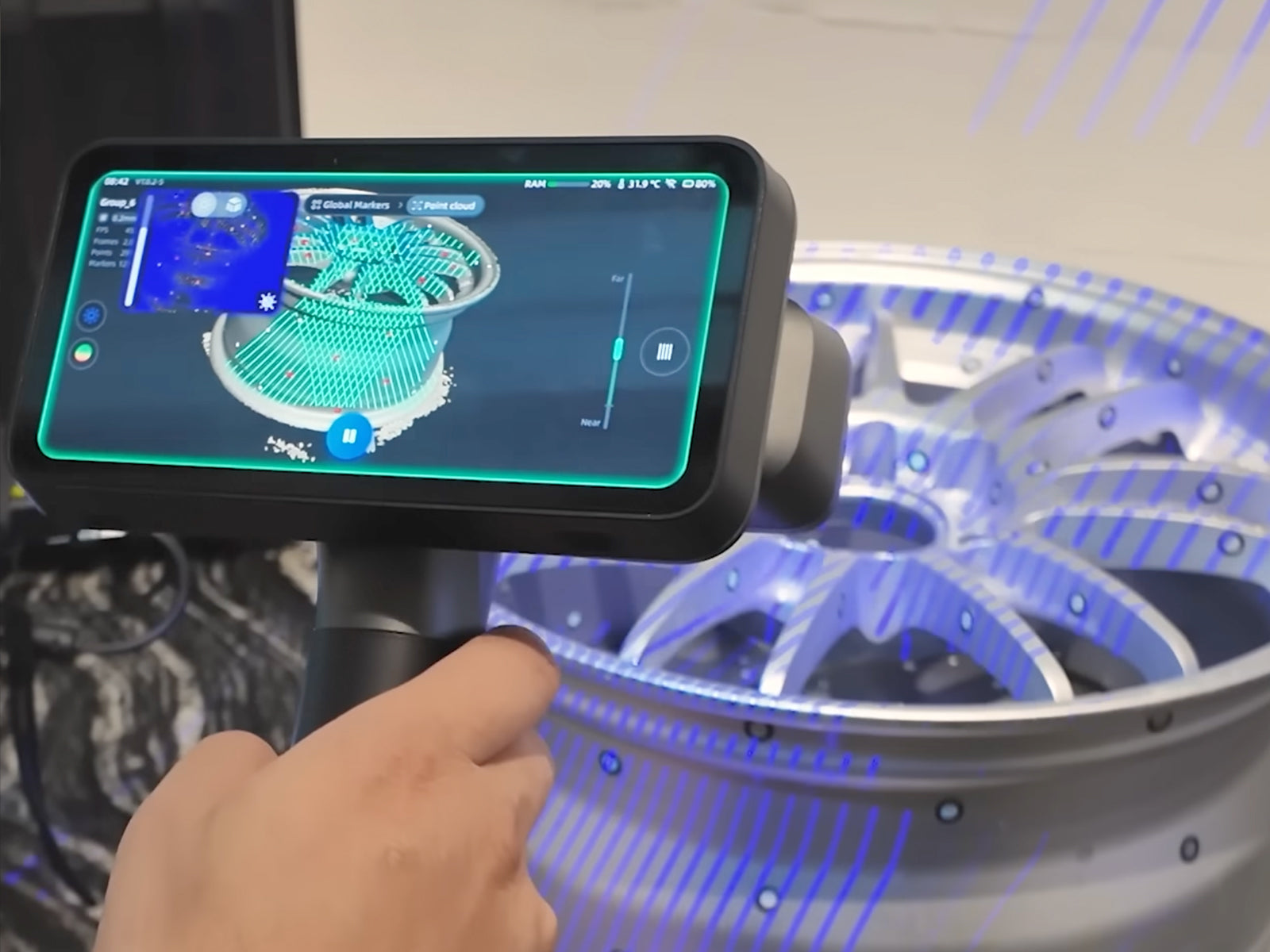
As industries accelerate their transition toward digital manufacturing, intelligent inspection, and spatial computing, 3D scanning technology is becoming an essential tool for connecting the physical and digital worlds. From product development and reverse engineering to quality inspection, construction, cultural heritage preservation, and robotics, 3D scanning enables users to capture real-world objects and environments with speed, accuracy, and efficiency.
Among the most widely adopted 3D scanning technologies are structured light scanning, laser scanning, and LiDAR. Each technology is based on a different measurement principle and is designed to solve different types of 3D data capture challenges. A structured light 3d scanner is often selected for close-range, high-resolution object scanning. A laser scanner 3d solution is widely used in industrial inspection, reverse engineering, and complex surface measurement. A 3d lidar scanner is typically preferred for long-range mapping, large spaces, and outdoor environments.
Understanding the differences between these technologies is critical for choosing the right solution for a specific workflow.
Structured Light 3D Scanning: High-Resolution Capture for Detailed Objects
Structured light 3D scanning uses projected light patterns to capture the surface geometry of an object. The scanner projects patterns such as stripes, grids, or coded light onto the target surface, while cameras record how the pattern changes across the object. Based on these distortions, the system calculates depth information and generates a 3D model.

A structured light 3d scanner is particularly effective for short-range scanning where fine detail is required. It is widely used in product design, digital modeling, healthcare, dental applications, cultural heritage preservation, and small-to-medium object digitization.
The key advantage of structured light scanning is its ability to capture dense and detailed surface data quickly. This makes it suitable for objects with complex curves, organic shapes, or fine surface features. In controlled lighting conditions, structured light scanning can deliver high-quality results with excellent visual and geometric detail.
However, structured light technology is more sensitive to environmental conditions. Strong ambient light, direct sunlight, reflective surfaces, transparent materials, and very dark objects may affect scanning performance. For best results, users often need a controlled environment or surface preparation.
For applications that require close-range detail and efficient object digitization, structured light remains a powerful and practical 3D scanning method.
Laser 3D Scanning: Precision, Stability, and Industrial Adaptability
Laser 3D scanning uses laser light to measure the distance and shape of an object. Depending on the system, a scanner may project a laser point, line, or multiple laser lines onto the surface. The reflected light is then analyzed to calculate accurate 3D geometry.
A laser scanner 3d system is commonly used in industrial environments where measurement reliability, repeatability, and surface adaptability are essential. Typical applications include automotive, aerospace, manufacturing, tooling, industrial design, part inspection, maintenance, and reverse engineering.

Compared with structured light scanning, laser scanning is often more robust in challenging working conditions. It can be a strong choice for scanning complex mechanical parts, metal components, dark surfaces, glossy materials, and objects that are difficult to capture with standard optical methods.
In professional workflows, advanced laser scanners are no longer only focused on accuracy. They are also becoming more portable, more intelligent, and easier to integrate into real-world production environments. This is where solutions such as EinScan Rigil demonstrate the evolving value of modern laser 3D scanning.
Designed for professional 3D data capture, EinScan Rigil represents a new generation of portable laser scanning solutions that combine precision, flexibility, and workflow efficiency. Instead of limiting users to a fixed scanning setup, advanced handheld laser scanners allow engineers, designers, and technicians to capture objects directly in workshops, production floors, repair centers, design studios, or field environments.
This flexibility is especially valuable for automotive aftermarket applications, reverse engineering, industrial product development, and complex part inspection. Instead of designing a complex object from scratch, users can scan an existing item and use the resulting 3D model as a digital starting point for redesign, analysis, customization, or manufacturing.
Another important advantage of using advanced laser scanners such as EinScan Rigil is their adaptability to difficult surfaces. In many real-world projects, users need to scan dark, metallic, reflective, or irregular objects. These materials can create challenges for many optical scanning systems. A professional laser scanner 3d solution can help reduce scanning preparation, improve data quality, and support more efficient geometry capture.
Modern laser scanners may also support features such as marker-free scanning, hybrid tracking, wireless operation, onboard processing, and high-resolution data acquisition. These capabilities can help reduce setup time, improve scanning mobility, and make professional 3D scanning more accessible to a wider range of users.
For companies pursuing digital transformation, this means faster product development cycles, more efficient inspection workflows, and better access to accurate 3D data. Laser scanning is no longer just a measurement tool; it is becoming a key part of the digital engineering ecosystem.
LiDAR 3D Scanning: Long-Range Spatial Data for Large Environments
LiDAR, short for Light Detection and Ranging, is a laser-based sensing technology that measures distance by emitting light pulses and recording the time it takes for the signals to return. By collecting a large number of measurements, a LiDAR system generates a point cloud of the surrounding environment.
A 3d lidar scanner is typically used for large-scale scanning rather than small-object digitization. It plays an important role in surveying, construction, architecture, mining, forestry, archaeology, robotics, autonomous driving, smart cities, and infrastructure management.
The main advantage of LiDAR is range. It can capture buildings, roads, bridges, tunnels, terrain, industrial sites, and urban environments efficiently. This makes it highly suitable for outdoor applications and large-area spatial mapping.
LiDAR technology is also important for real-time perception. In robotics and autonomous vehicles, LiDAR helps systems detect obstacles, estimate distances, and understand surrounding environments. In construction and architecture, it supports site documentation, progress monitoring, and digital twin creation.
However, LiDAR is not typically designed for capturing very fine surface details on small objects. While a 3d lidar scanner can capture large spaces efficiently, it usually cannot match the fine resolution of a close-range structured light scanner or a professional industrial laser scanner.
For projects where distance, coverage, and environmental mapping are the top priorities, LiDAR remains the preferred technology.
Technology Comparison: Different Sensors for Different Digital Workflows
Structured light, laser scanning, and LiDAR are not competing versions of the same tool. They represent different approaches to 3D data acquisition.
A structured light 3d scanner is optimized for close-range, high-density surface reconstruction. It is well suited for detailed objects, human body scanning, product design, and digital modeling.
A laser scanner 3d solution is designed for precision-driven industrial workflows. It provides strong measurement reliability and greater adaptability for complex geometries, mechanical parts, and challenging materials.
A 3d lidar scanner is built for long-range spatial capture. It is best suited for buildings, infrastructure, terrain, construction sites, and large outdoor environments.
The best choice depends on the target object, required accuracy, scanning distance, surface material, operating environment, and final use of the 3D data.
Choosing the Right 3D Scanning Solution
For organizations investing in 3D scanning technology, the decision should begin with the application scenario.
If the goal is to capture small or medium-sized objects with fine detail, structured light scanning is often an efficient choice. If the workflow requires industrial-grade reliability, flexible scanning, and strong performance on difficult surfaces, laser scanning is often more suitable. Advanced devices such as EinScan Rigil can provide a practical balance of precision, portability, and workflow efficiency for professional users. If the project involves large-scale mapping, outdoor environments, or spatial perception, LiDAR is the more scalable solution.
As 3D scanning becomes more deeply integrated into digital manufacturing, smart inspection, and AI-powered design workflows, users will increasingly need solutions that are not only accurate, but also portable, intelligent, and easy to deploy.
Conclusion
The future of 3D scanning is not defined by a single technology, but by the ability to match the right sensing method with the right application. Structured light, laser scanning, and LiDAR each bring unique advantages to the digital capture process.
Structured light delivers high-density data for close-range detail. Laser scanning provides the precision, adaptability, and workflow flexibility required by industrial users. LiDAR enables long-range perception and large-scale environmental mapping.
As the demand for digital twins, reverse engineering, intelligent inspection, and automated design continues to grow, advanced 3D scanning solutions will play an increasingly important role in industrial innovation. Technologies such as EinScan Rigil highlight this shift by bringing professional laser scanning into more flexible, real-world workflows.
For businesses, engineers, designers, and creators, choosing the right 3D scanning technology is no longer just a hardware decision. It is a strategic step toward faster development, smarter production, and more accurate digital transformation.
Share:
From 3D Scanning to 3D Printing: Complete Workflow